

Views: 0 Author: Site Editor Publish Time: 2026-11-05 Origin: Site


Electric vehicle adoption is accelerating rapidly, shifting from a niche market into a standard transportation requirement. Consequently, commercial facilities ranging from retail plazas to highway convenience stores face mounting pressure to deliver fast and reliable charging solutions. However, many property developers and fleet managers stumble over a critical engineering decision: sizing. Selecting equipment with insufficient output inevitably leads to prolonged wait times and deeply frustrated customers. Conversely, over-sizing hardware results in stranded capital, severely underutilized assets, and potentially massive electrical grid upgrade costs.
The commercial DC fast charger remains the premier solution for rapid energy transfer. This comprehensive guide outlines the precise methodology to accurately size power output, assess electrical capacity, determine optimal port counts, and plan physical layouts for a sustainable and profitable deployment.
A commercial DC fast charger represents the highest tier of electric vehicle charging infrastructure available today. Unlike Level 2 chargers that deliver alternating current to the vehicle and rely on the onboard converter to change it to direct current, a DC fast charger handles the heavy lifting of power conversion externally. Bypassing onboard limitations allows these robust industrial units to deliver high-voltage direct current straight to the battery. This fundamental architectural difference reduces charging times from several hours to mere minutes.
Deploying electric vehicle infrastructure requires substantial capital expenditure. Poor sizing introduces severe financial and operational risks. If the equipment is undersized at a bustling highway rest stop, drivers will experience unacceptable queuing. This leads to poor customer satisfaction and damaged brand reputation. Installing a 350-kilowatt ultra-fast charger at a sit-down restaurant results in wasted capital because extreme power output is entirely unnecessary for long-dwell customers.
Proper sizing must be approached holistically. It encompasses three distinct engineering categories: power output, the total number of dispensing ports, and site infrastructure including both electrical grid capacity and physical real estate.
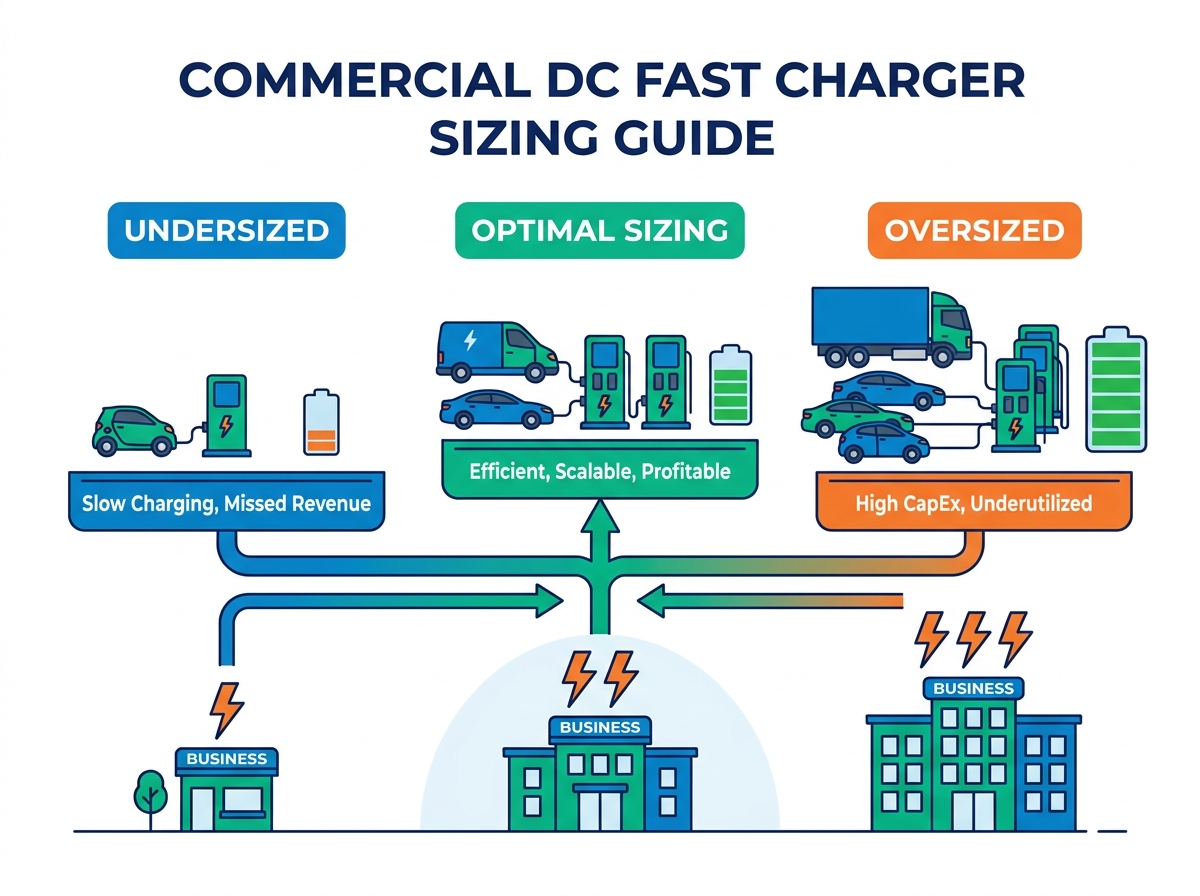
Before reviewing hardware specifications or electrical requirements, you must critically analyze your specific operational model. Dwell time is defined as the average duration a vehicle remains parked at your facility. It is the single most important factor in this equation. Aligning charger speed with the natural dwell time of visitors ensures optimal utilization and prevents drivers from monopolizing spaces long after their battery is full.
For retail centers, shopping malls, and sit-down dining establishments, average customer dwell time typically ranges from 30 to 90 minutes. Ultra-fast charging is economically inefficient in these scenarios. Businesses should instead focus on mid-range DC fast chargers. A mid-range output provides a meaningful battery top-up while the customer shops or eats. This encourages longer store visits without tying up the asset all afternoon.
Highway travel plazas and traditional gas stations operate on a high-turnover model. The primary objective for drivers in these locations is to charge their vehicles in 15 to 20 minutes, grab a coffee, and immediately return to the road. Therefore, these locations demand maximum power output. Ultra-fast charging infrastructure is mandatory here to facilitate quick turnaround times and match the fast-paced nature of the existing business.
Commercial fleets including delivery vans and rental car agencies must size their stations based on strict route schedules and vehicle battery capacities. If a delivery fleet returns to a depot and parks overnight for 8 to 10 hours, lower-powered DC chargers may suffice. Continuous shift models, such as electric transit buses requiring rapid top-ups between routes, make high-power DC fast charging an operational necessity to minimize vehicle downtime.
Once you have established average dwell time, the next logical phase is matching that metric with the appropriate power output tier. Commercial DC fast chargers are generally categorized by their kilowatt rating, which directly dictates the speed of energy transfer to the vehicle.
The 30 to 60 kilowatt range serves as the entry-level tier for DC fast charging. These units typically add 100 to 200 miles of range per hour of charging. This power level is highly suitable for auto dealerships, workplace parking lots, and smaller fleet depots where drivers are expected to park for 1 to 2 hours. The primary advantage of this tier is its relatively low impact on the local electrical grid, often allowing businesses to install hardware without requiring massive utility transformer upgrades.
For the vast majority of public-facing businesses, the 120 to 180 kilowatt range is considered the optimal balance of speed and infrastructure cost. Chargers in this tier can typically charge a standard battery from 20 percent to 80 percent in approximately 20 to 40 minutes. This makes them the premier choice for grocery stores and retail plazas. When procuring hardware for these locations, selecting a reliable commercial EV charging station ensures customers receive a premium, rapid charging experience without forcing the property owner to undertake extreme grid overhauls.
The 350-kilowatt and above tier represents the absolute pinnacle of current charging technology. These ultra-fast chargers can add up to 20 miles of range per minute, catering specifically to highway corridors and heavy-duty electric trucks. While the performance is undeniably impressive, deploying chargers at this scale requires massive electrical infrastructure. Due to the exponential increase in hardware and installation costs, these units are generally reserved for specialized charging hubs.
Recent market analyses highlight a distinct industry shift toward smart load management and battery-buffered charging systems. Because local utility grids are frequently constrained and unable to deliver megawatts of power on demand, developers are increasingly adopting commercial chargers equipped with integrated Battery Energy Storage Systems. This trending approach allows businesses to offer ultra-fast charging speeds by drawing power from internal batteries during peak times. It effectively circumvents the need for massive utility grid upgrades while providing grid-resilient infrastructure.
It is a fundamental rule of engineering that you cannot accurately size a charger without first sizing your electrical grid. The electrical assessment is frequently the most expensive, complex, and overlooked phase of the entire installation process.
Property owners must commission a comprehensive site load study before purchasing any hardware. This study is conducted by a licensed commercial electrician or electrical engineer to measure the existing electrical demand of your building. In practice, an electrician will attach a data logger to your main switchgear for 30 days to measure peak draw before calculating exactly how much spare capacity remains. If your facility lacks sufficient amperage, you will not be able to install high-powered DC chargers without significant modifications.
When a site load study reveals insufficient electrical capacity, infrastructure upgrades become mandatory. To support multiple DC fast chargers, businesses often need to install new heavy-duty switchgears and step-down transformers. Furthermore, if the local utility grid cannot deliver the required power to your property line, you must coordinate with the utility company to trench and extend new medium-voltage lines to the site. This civil engineering process can add months to your project timeline.
Sizing also involves determining the exact quantity of individual charging cables or ports your facility requires. Installing too few ports leads to queuing and customer frustration, while installing too many ties up precious capital in underutilized assets.
Businesses should employ a data-driven framework to calculate the optimal number of ports. Start by analyzing current adoption rates in your specific municipality. Next, estimate your daily vehicle traffic and the percentage of those visitors likely to drive an electric vehicle. In the commercial charging industry, a daily utilization rate of 15 to 25 percent per port is generally targeted. This ensures the station is profitable without being constantly overcrowded.
Trenching through reinforced concrete and upgrading electrical panels are the most disruptive parts of installation. Businesses should heavily practice future-proofing by deploying make-ready infrastructure. Even if current utilization models suggest you only need two units today, you should lay the underground conduit, pour the concrete pads, and pull the electrical wiring for four to six ports. When demand inevitably increases, you can simply bolt down new DC fast chargers, avoiding the need to tear up your parking lot a second time.
Unlike compact wall-mounted units, commercial DC fast chargers are substantial pieces of industrial equipment. They require significantly more physical space, and site layout planning must account for both hardware dimensions and strict accessibility regulations.
High-powered charging systems often utilize a split system architecture. In this configuration, the heavy power conversion cabinet is installed in a remote location behind a building or landscaping screens. A sleek user-friendly dispenser is placed directly at the parking space. Property developers must allocate sufficient square footage for both components, along with the necessary underground conduit pathways connecting them. Equipment requires a minimum of 3 to 4 feet of clearance on all sides to allow technicians to perform routine maintenance safely.
Physical sizing extends to the parking spaces themselves. Stations must comply with the Americans with Disabilities Act or local equivalent accessibility standards. This requires wider parking stalls and dedicated access aisles to accommodate wheelchair users. Specifically, because liquid-cooled cables on high-power dispensers can weigh upwards of 20 pounds, physical layouts must incorporate robust cable management systems. Tall bollards and mechanical retraction systems are necessary to keep heavy cables off the ground, preventing trip hazards and protecting expensive cords from being run over.
For decision-makers, sizing is not merely a technical specification. It is the primary variable that dictates both initial Capital Expenditure and ongoing Operational Expenditure. A meticulously calculated approach to financial modeling ensures a sustainable Return on Investment.
The initial procurement and installation costs of a commercial DC fast charger scale exponentially with its kilowatt output. Higher power outputs require more sophisticated internal components, heavier gauge copper cabling, and advanced thermal management systems.
Site preparation frequently equals or exceeds the cost of the charging units themselves. Trenching through existing asphalt to lay conduit, upgrading electrical panels, and installing heavy-duty switchgear require specialized labor. The following table outlines estimated cost variations based on different power tiers to provide an empirical baseline for financial planning.
| Charger Power Tier | Estimated Hardware Cost Per Unit | Estimated Installation Cost Per Unit | Ideal Business Application |
|---|---|---|---|
| 30 to 60 Kilowatts | $15,000 to $25,000 | $10,000 to $20,000 | Retail, office parks, auto dealerships |
| 120 to 180 Kilowatts | $40,000 to $70,000 | $30,000 to $60,000 | Commercial plazas, dining, regional transit |
| 350 Kilowatts and Above | $85,000 to $140,000+ | $60,000 to $100,000+ | Highway corridors, heavy-duty fleet hubs |
One of the most critical operational costs associated with running a commercial DC fast charger is the utility demand charge. Commercial tariffs include a demand charge based on the highest peak power draw recorded over a brief interval during the billing cycle. If a business installs a 150-kilowatt charger and a vehicle utilizes its maximum capacity for just 15 minutes, the utility company may levy a demand charge based on that peak for the entire month.
Properly sizing your station is the first line of defense. If customers typically park for an hour, deploying a 60-kilowatt charger naturally limits your peak grid draw. Additionally, implementing smart charge management software dynamically balances the load across multiple dispensers, ensuring the total site draw never exceeds a predetermined threshold. To explore systems with built-in dynamic load balancing, reviewing a high-performance EV charging station can provide clarity on available technical specifications.
Calculating true profitability requires a comprehensive Total Cost of Ownership analysis. Beyond capital expenditure and utility bills, businesses must account for network management fees, cellular connectivity for payment processing, and routine maintenance. Carefully sizing hardware to match realistic utilization forecasts helps optimize costs and accelerate the path to profitability.
The final step in deploying a successful infrastructure project is selecting the right hardware manufacturer. Procurement decisions should be based on empirical reliability data, supply chain transparency, and the ability to provide long-term technical support.
Hardware uptime is the most critical metric for success in the commercial sector. A charger that frequently goes offline disrupts operations and incurs high emergency maintenance costs. Scalability is equally crucial. As electric vehicle adoption continues to accelerate, the demand for faster charging speeds will inevitably increase. Purchasing rigid infrastructure can lead to premature obsolescence.
Forward-thinking businesses are increasingly turning to modular hardware architectures. A modular commercial DC fast charger features a large chassis that can accommodate multiple internal power modules. Property owners can add power modules sequentially as traffic grows. This effectively future-proofs the site without requiring entirely new dispensers or additional concrete trenching. For tailored solutions that offer this modularity, partnering with a specialized EV charging equipment supplier ensures your investment scales alongside market demand.
Proper sizing is the absolute foundation of a profitable and stress-free charging business. It requires a delicate balance between customer dwell time, desired power output, and the existing electrical capacity of your facility. Accurately calculating port counts and meticulously planning your physical space prevents operational bottlenecks and exorbitant installation costs. Always evaluate your site electrical infrastructure before purchasing any hardware. Partnering with manufacturers that offer reliable, modular equipment secures long-term success. If you are ready to select the exact hardware specifications for your project, explore our comprehensive range of commercial EV charging stations to find the perfect fit for your business needs.
The physical footprint required is substantially larger than that of standard parking spaces or Level 2 chargers. A standard parking space is typically 9 feet wide by 18 feet long. You must allocate an additional 3 to 5 feet of clearance at the head or side of the space for the dispenser unit, protective bollards, and cable management systems. High-power systems often utilize a split architecture, requiring a separate hidden area to house large power cabinets and cooling units. Planners must also account for wider aisles and accessible routes to ensure strict compliance with the Americans with Disabilities Act or local accessibility regulations.
Yes, upgrading the power output is entirely possible if you initially invest in a modular commercial DC fast charger. Modular systems are designed with a primary chassis that can house multiple independent power modules. If your site has sufficient electrical grid capacity, you can increase a unit's output simply by purchasing and inserting additional power modules into the existing cabinet. This requires a software configuration update and potentially a licensing fee, but it eliminates the need to replace the entire dispenser or perform new civil engineering work.
The timeline for installing a commercial DC fast charging station typically ranges from 3 to 9 months, depending on site complexity and utility involvement. The initial phase involves site assessments, electrical load studies, and securing municipal permits, which can take 4 to 8 weeks. Hardware procurement lead times vary by manufacturer but often span 8 to 12 weeks. If your site requires a utility transformer upgrade or new medium-voltage lines, coordination with the local utility company can add several months to the timeline. Actual physical construction generally takes 2 to 4 weeks, followed by final inspections and commissioning.
The primary difference lies in the charging speed, the type of electrical current delivered, and the ideal business use case. Level 2 chargers deliver alternating current to the vehicle, relying on the onboard inverter to convert it to direct current. This process is slower, typically adding 20 to 30 miles of range per hour, making Level 2 ideal for workplaces, hotels, or residential buildings where vehicles park for several hours. A commercial DC fast charger bypasses the onboard inverter, delivering high-voltage direct current directly to the battery. This allows for rapid charging, adding hundreds of miles of range in 20 to 40 minutes, which is essential for highway corridors, retail plazas, and quick-turnaround fleet operations.
Whether you need a new utility transformer depends entirely on the existing spare capacity of your site electrical grid and the total kilowatt output of the chargers you intend to install. A single 30-kilowatt or 50-kilowatt unit can sometimes be integrated into an existing electrical panel without major upgrades. However, installing multiple high-power units requires massive electrical overhead. In these scenarios, the existing infrastructure is rarely sufficient. You will almost certainly need to work with your local utility provider to install a dedicated step-down transformer and potentially route new medium-voltage power lines to your property.
Annual maintenance costs for commercial DC fast chargers typically range from 1,000 to 3,000 dollars per unit. This includes routine inspections, replacing air filters in the cooling systems, inspecting the heavy-duty liquid-cooled cables for wear, and testing the software connectivity. Preventive maintenance is crucial because commercial environments expose the hardware to extreme weather and heavy physical use. Budgeting for a comprehensive service level agreement with your hardware provider ensures maximum uptime and protects your initial investment.
Installing commercial EV charging infrastructure requires a combination of electrical, building, and sometimes environmental permits depending on your municipality. You will need an electrical permit to upgrade panels, install new switchgear, and run underground conduit. A building permit is often required for pouring concrete pads and installing protective bollards. Additionally, local zoning boards may require a site plan review to ensure the new layout complies with parking ratios and accessibility standards. Engaging a specialized engineering firm early in the process helps navigate these regulatory hurdles efficiently.


