

Views: 0 Author: Site Editor Publish Time: 2026-10-22 Origin: Site


Are long queues driving your customers to competitors? Slow fueling hurts daily revenue and deeply frustrates drivers who are eager to hit the road. Choosing the wrong dispensing capacity creates massive forecourt bottlenecks. Conversely, an overly aggressive pumping speed leads to hazardous splash-backs and environmental liabilities. How do you strike the perfect balance? In this guide, we break down the engineering reality of fluid transfer. You will learn exactly how to select the ideal hardware to maximize station throughput and daily profits.
Fuel dispenser flow rate refers to the volume of liquid transferred from the underground storage tank into a vehicle within a specific timeframe. Industry standards measure this critical metric in gallons per minute in the United States, or liters per minute in metric-based regions. Acting as the mechanical heartbeat of your station, it remains the core performance indicator of any fueling operation.
The business impact of this metric cannot be understated. Fluid transfer speed directly governs station throughput, which is the total number of vehicles a forecourt can process during peak hours. Consider a practical scenario. Increasing a pump speed by just two gallons per minute can shave over a minute off a single transaction. Across a busy afternoon with multiple pumping islands, this marginal increase allows a station to serve dozens of additional customers. Consequently, this efficiency directly boosts daily fuel volume and drives lucrative convenience store sales.
From a customer experience perspective, driver psychology is remarkably simple. Consumers despise waiting. A sluggish pump leads to visible queues, negative online reviews, and ultimately, lost repeat business. Furthermore, fleet drivers operate on strict schedules where time literally equates to money. Beyond mere convenience, properly matched flow rates reduce unnecessary strain on your pumping equipment. Forcing a high-capacity motor to push liquid through restrictive piping accelerates mechanical wear. Overworking a standard pump for high-volume commercial needs yields the same destructive result. This misalignment inevitably leads to premature equipment failure.
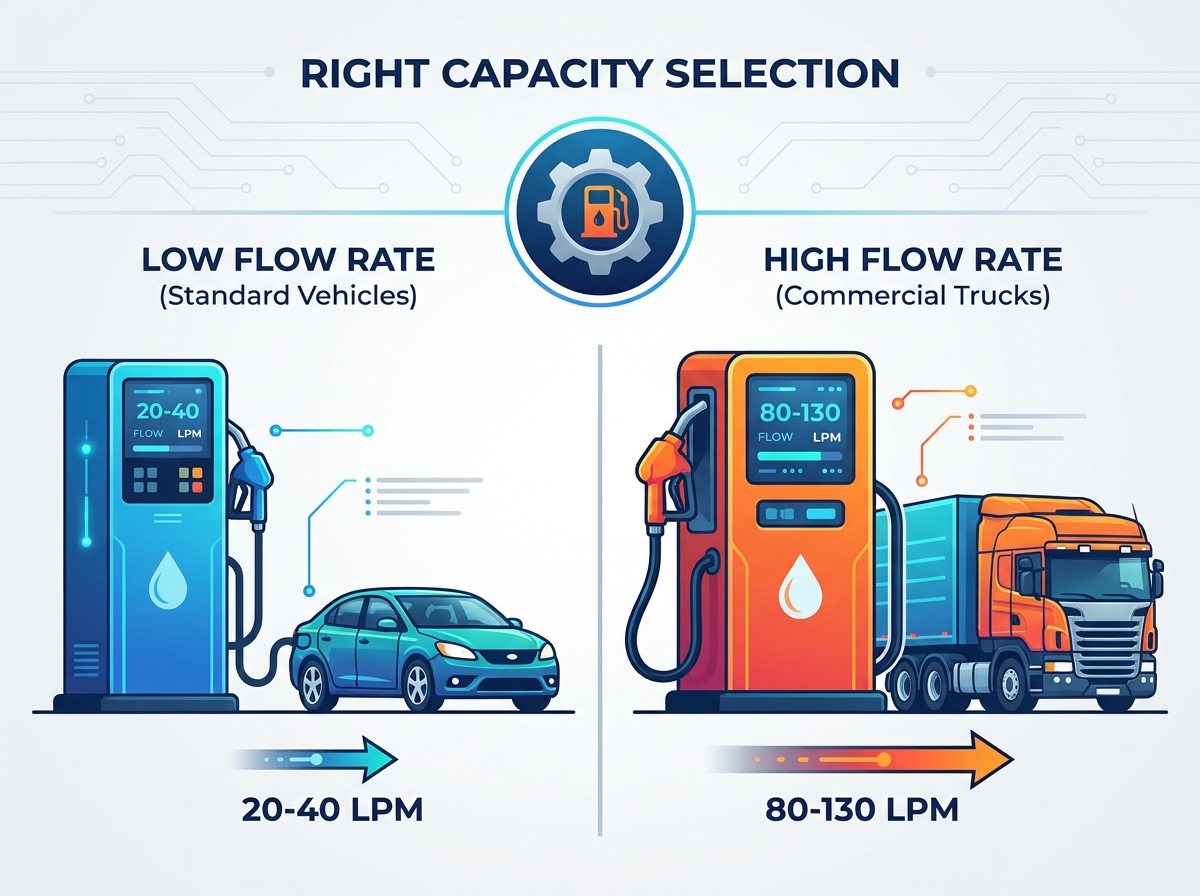
Selecting the correct equipment requires a thorough understanding of the primary flow rate categories. Engineers meticulously design each tier for specific vehicle demographics, fluid volumes, and regulatory environments.
For retail gas stations catering to everyday commuters, standard flow rates are the industry norm. The ideal range for these units sits at approximately 10 gallons per minute, or roughly 40 liters per minute. This specific limit is not arbitrary. It represents a regulatory maximum enforced by environmental and safety agencies worldwide. Capping the speed prevents dangerous splash-back. Specifically, it minimizes the release of volatile organic compounds into the atmosphere and ensures the automatic nozzle shut-off mechanism has adequate time to react before the tank overfills.
Highway travel centers, truck stops, and commercial fleet yards require entirely different hardware. High-flow rates range from 22 to 40 gallons per minute. This accelerated capacity is an absolute necessity for commercial diesel trucks equipped with dual saddle tanks that often hold over 100 gallons each. A standard consumer pump would leave a truck driver idling for over fifteen minutes just to fuel up. To expedite this process, truck stops often utilize dual-nozzle master and satellite systems. This setup allows a driver to fill both the driver-side and passenger-side saddle tanks simultaneously. Selecting a commercial-grade fuel dispenser designed specifically for high-flow diesel is critical for maintaining efficiency in these demanding environments.
For specialized industrial applications, standard and high-flow rates remain woefully insufficient. Ultra-high flow rates deliver over 100 gallons per minute. These massive systems are utilized in mining operations, aviation fueling, marinas, and heavy-duty industrial fleet yards. Handling this extreme fluid velocity without causing hydraulic shock requires specialized high-capacity hoses, heavy-duty safety breakaways, and massive underground piping manifolds.
Purchasing a unit with a high-rated output does not automatically guarantee you will achieve that speed at the nozzle. Several interconnected physical and mechanical factors heavily influence your station's actual operational capacity.
Recent market analyses examining fueling infrastructure trends reveal a distinct shift toward alternative fuels and hybrid station models. As commercial logistics networks expand and fleets increasingly adopt high-efficiency biodiesel blends, the demand for adaptable dispensing infrastructure has skyrocketed. Operators are rapidly moving away from rigid, single-purpose setups. Instead, industry data indicates that stations equipped with modular, high-capacity systems are capturing a larger market share. They can seamlessly pivot to serve both traditional passenger cars and heavy-duty commercial vehicles without requiring complete forecourt overhauls. This prevailing trend proves that future-proofing your investment with versatile equipment is no longer optional.
Station owners must conduct a thorough traffic analysis prior to upgrading equipment. A highway travel center adjacent to a major interstate requires a heavy focus on high-flow diesel lanes to accommodate semi-trucks. Conversely, a suburban retail station will primarily serve passenger vehicles, making standard flow rates the safest and most compliant choice. Commercial fleet yards often require a hybrid approach. They seamlessly mix standard flow for light-duty delivery vans and high-flow for heavy-duty box trucks.
The physical properties of the liquid dictate the required pumping technology. Driven by these characteristics, diesel setups are typically engineered for higher flow rates than gasoline. However, diesel fuel has a natural tendency to foam when pumped at high velocities. If a high-flow system lacks specialized nozzles and internal air elimination mechanisms, the rising foam will prematurely trigger the automatic shut-off sensor. This forces the driver to pump the fuel at a frustrating trickle, entirely negating the benefits of your expensive high-flow investment.
The method by which fuel is drawn from the underground storage tank heavily influences the maximum achievable speed. Suction pumps feature a built-in motor inside the cabinet and pull liquid using atmospheric pressure. They are generally slower and can only draw liquid from relatively short distances. In stark contrast, modern fuel dispenser systems at high-volume retail locations rely on submersible turbine pumps. Submerged directly inside the underground tank, these powerful motors push the liquid up and out under high pressure. They are significantly faster and can effortlessly serve multiple lanes simultaneously from a single tank.
Pumping hardware cannot defy physics. Fluid dynamics dictate that your maximum velocity is entirely bottlenecked by the narrowest point in your piping manifold. If your underground pipes are too narrow, friction loss will severely restrict the output. Upgrading to a 40-gallon-per-minute dispenser on a 1.5-inch pipe will only result in overworked motors, elevated electricity bills, and a flow rate that stubbornly hovers around 15 gallons per minute.
Determining the optimal capacity requires empirical data and careful calculation. Station owners should follow a systematic approach to ensure their infrastructure matches their commercial goals.
Step 1: Estimate Peak Hour Traffic. Determine the maximum number of vehicles you expect to serve during your busiest hour. For example, a thriving suburban station might see one hundred passenger cars per hour during the morning commute.
Step 2: Determine Average Fill-Up Size. Analyze your historical sales data. A typical passenger car may take 15 gallons, while a commercial transport truck may take upwards of 100 gallons.
Step 3: Calculate the Required Output. To move that volume of liquid within an acceptable wait time, calculate the necessary output. For instance, dividing 15 gallons by a three-minute target equals a five-gallon-per-minute minimum requirement per nozzle. Given that customers spend time paying and parking, a standard 10-gallon-per-minute pump ensures the physical fueling takes only 1.5 minutes.
Calculations must also account for simultaneous usage. If a single two-horsepower submersible pump is rated to push 60 gallons per minute, and only one nozzle is active, it easily delivers maximum flow. However, if four nozzles connected to that same pump activate simultaneously, the flow is divided. Buyers must size their pumps, piping manifolds, and dispensers as a unified system to prevent pressure drops during rush hour.
Selecting the appropriate dispensing capacity is not merely a technical specification. It is a critical operational decision that directly influences profitability, safety compliance, and overall customer satisfaction. Misaligning capacity with your target demographic creates hidden financial burdens.
A restricted or inherently slow pumping velocity creates immediate operational bottlenecks. The most direct consequence is lost revenue resulting from drive-offs. Modern consumers prioritize speed. When drivers observe long queues at the island, a significant percentage will simply bypass the station. For commercial applications, the financial impact is even more pronounced. If a commercial truck driver is forced to spend twenty minutes filling a massive saddle tank at a standard commuter pump, the fleet incurs unnecessary hourly labor costs. Over a year, these accumulated delays can prompt lucrative commercial accounts to terminate their contracts.
Conversely, installing a high-capacity pump for standard passenger vehicles introduces severe safety hazards. Consumer vehicles feature narrow filler necks designed to accept a specific maximum volume. Forcing liquid into the tank at 20 gallons per minute causes immediate splash-backs. This mismatch leads to dangerous spills and environmental contamination requiring costly hazardous material cleanup. Mechanically, the rapid backflow constantly triggers the shut-off sensor, forcing the customer to repeatedly squeeze the handle. Furthermore, exceeding legal consumer pumping speed limits can trigger compliance audits and substantial financial penalties.
If your station is experiencing a sudden or gradual decrease in fueling speed, a complete equipment replacement may not be immediately necessary. Often, diminished output is a symptom of underlying maintenance issues within the underground infrastructure or internal hydraulics.
The single most common cause of restricted fluid transfer is a clogged filter. Dispensers utilize specific micron filters to prevent particulates and rust from entering the customer's vehicle. As these filters trap contaminants over time, hydraulic resistance increases, naturally slowing the output. Replacing a saturated filter is the first and most cost-effective diagnostic step.
If the motor within the underground tank begins to fail, or if the turbine blades become worn, the system will lose its ability to maintain adequate line pressure. Operators can usually identify pump failure if the speed drops significantly only when multiple nozzles are authorized and operating at the exact same time.
Physical degradation of external hanging hardware can severely restrict fluid dynamics. Kinks in the hose, worn swivel joints, or partially engaged breakaway valves create unnatural choke points. Breakaway valves are designed to snap and seal if a customer drives off with the nozzle. However, they can sometimes partially separate due to minor impacts, heavily restricting the liquid until properly reconnected.
To prevent catastrophic environmental contamination, pressurized lines are equipped with mechanical line leak detectors. If a detector senses a loss of pressure in the underground piping, it intentionally restricts the flow to a crawl. This slow-flow state is a critical safety feature requiring immediate investigation by a certified technician.
| Symptom Observed | Potential Root Cause | Recommended Action |
|---|---|---|
| Slow flow on one specific nozzle | Clogged micron fuel filter | Replace the specific fuel filter. |
| Slow flow across all gasoline pumps | Failing submersible turbine pump | Test line pressure; schedule maintenance. |
| Sudden drop to a trickle on all pumps | Tripped line leak detector | Halt operations; test underground piping for leaks. |
| Visible restriction or bulging on hose | Degraded hose or partially separated breakaway | Replace the affected hose or breakaway valve immediately. |
When troubleshooting reveals that the existing equipment has reached the end of its operational lifespan, upgrading to modern infrastructure becomes necessary. Selecting the right hardware requires evaluating several technical specifications to ensure the new units can meet your volume demands.
Modern forecourts require high adaptability. When evaluating new hardware, prioritize units equipped with advanced positive displacement gear meters and electronic calibration valves. These industrial-grade components maintain exact volumetric accuracy even when pushing high volumes of liquid. Intelligent proportional valves allow certified technicians to fine-tune the output to match the precise limits of your underground infrastructure, ensuring you remain compliant while maximizing speed.
High-flow dispensing puts immense mechanical stress on internal components. Pushing 40 gallons of diesel per minute requires highly robust internal hydraulics. Prioritize units constructed with corrosion-resistant materials. This is particularly vital if your station dispenses alternative fuels like biodiesel or ethanol blends, which can chemically degrade standard rubber seals over time.
Achieving an optimal pumping velocity is ultimately pointless if the customer is forced to spend three minutes interacting with a slow, outdated payment terminal. The speed of the digital transaction is just as critical to station throughput as the physical fluid transfer. Ensure your new hardware features EMV-compliant card readers, contactless functionality, and seamless fleet card integration.
Upgrading a station's infrastructure is a significant capital expenditure. It is vital to partner with reputable manufacturers that provide comprehensive warranties, accessible technical support, and a reliable supply chain. Exploring catalogs for high-performance fuel dispensers ensures that station owners can source equipment specifically engineered for their unique hydraulic requirements, minimizing downtime and maximizing operational efficiency.
Choosing the optimal dispensing capacity requires a careful balancing act. You must align customer convenience, specific vehicle requirements, and strict environmental safety regulations to maintain a profitable forecourt. Upgrading to high-capacity equipment is a highly lucrative move, provided it is matched with the correct underground infrastructure, properly sized piping, and robust submersible pumps.
We encourage you to assess your current station throughput today. By identifying operational bottlenecks and analyzing your peak hour traffic, you can make informed, data-driven decisions. If you are ready to upgrade your forecourt, visit Bei-Lin to explore our extensive range of reliable fuel dispensing equipment. Find the perfect engineering match to keep your station competitive, compliant, and highly profitable for years to come.
In the United States, the Environmental Protection Agency legally limits consumer gasoline pumps to a maximum output of 10 gallons per minute. This regulation is strictly enforced to prevent hazardous vapor releases, splash-backs, and environmental spills during the fueling process. Similar regulatory frameworks exist globally, with most international standards capping consumer outputs between 40 and 50 liters per minute to ensure the safety of the general public.
Yes, upgrading is possible, but it requires a comprehensive overhaul of more than just the external cabinet. A high-capacity pump requires a larger volume of fluid delivery. To achieve this, you will likely need to upgrade to a one-inch dispensing hose, install high-flow nozzles, and utilize higher-capacity micron filters. Most importantly, you must verify that your underground submersible pump and the diameter of your underground piping can physically handle the increased volume without causing cavitation or severe pressure drops.
Diesel fuel possesses unique chemical properties that make it highly sensitive to temperature drops. In cold weather, the paraffin wax inherent in diesel begins to crystallize and gel, significantly increasing the fluid's overall viscosity. As the liquid thickens, it becomes much harder for the underground motor to push it through the micron filters. This cold-weather gelling is a primary cause of severely reduced dispensing speeds during winter months. Using winterized diesel blends or installing heated filter housings can successfully mitigate this issue.
Flow rates should ideally be monitored continuously through your station's electronic point-of-sale and inventory management systems. A sudden, unexplained drop in speed usually indicates an immediate mechanical issue, such as a clogged filter or a tripped mechanical line leak detector. For proactive maintenance, technicians should perform manual bucket tests using a calibrated volumetric prover at least semi-annually. This verifies that the meters remain accurate and the speed meets operational standards.
Standard flow dispensers utilize a single nozzle to fill one tank at a time, which is perfectly sufficient for passenger cars. Master satellite systems, however, are engineered specifically for large commercial semi-trucks equipped with dual saddle tanks on opposite sides of the cab. This system allows the truck driver to authorize payment once at the master unit, then pull a secondary hose to the opposite side of the truck. By fueling both tanks simultaneously, the system effectively doubles the overall fluid transfer speed delivered to the vehicle.
Pipe diameter is a primary factor in fluid dynamics. Narrow pipes create immense friction against the liquid being pumped, known as friction loss. If you attempt to push a high volume of liquid through a narrow pipe, the hydraulic resistance increases exponentially. This resistance chokes the output at the nozzle and forces the underground pump motor to work harder, leading to overheating and premature failure. Upgrading to larger diameter piping reduces friction, allowing the liquid to travel faster and more efficiently.
A nozzle clicking off prematurely is usually caused by a mismatch between the pumping speed and the vehicle's filler neck capacity. If the liquid enters the tank faster than it can settle, it backs up into the filler neck and covers the small sensor hole at the tip of the nozzle, triggering the automatic shut-off. This can also happen if the station's vapor recovery system is malfunctioning, or if the vehicle's internal charcoal canister vent is clogged, preventing displaced air from escaping the tank.


