

Views: 225 Author: Site Editor Publish Time: 2025-10-22 Origin: Site


In fuel-retailing and forecourt engineering, confusion often arises between the terms “fuel pump” and “fuel dispenser.” To many users they seem interchangeable: both deliver fuel to vehicles. However, the from-tank architecture, energy dynamics, system layout, servicing needs, and commercial implications differ meaningfully. This article unpacks the distinction between a fuel pump and a fuel dispenser, using comparative frameworks, operational insight, and real-world trade-offs. We also reference how the YX Fuel dispenser fits into this landscape as an example of a modern dispenser product line.
By the end, you will understand precisely how a pump differs from a dispenser, when one is preferable, and what to ask when selecting, maintaining, or upgrading fuel delivery equipment at a gas station or forecourt operation.
To address the question “what is the difference between a fuel pump and a fuel dispenser?”, it’s useful to break down core functional roles, physical placement, and system-level context.
A fuel pump in the fuel-retail context often refers to a self-contained pumping mechanism (above ground) that suctions fuel from the underground storage tank (UST) to the nozzle.
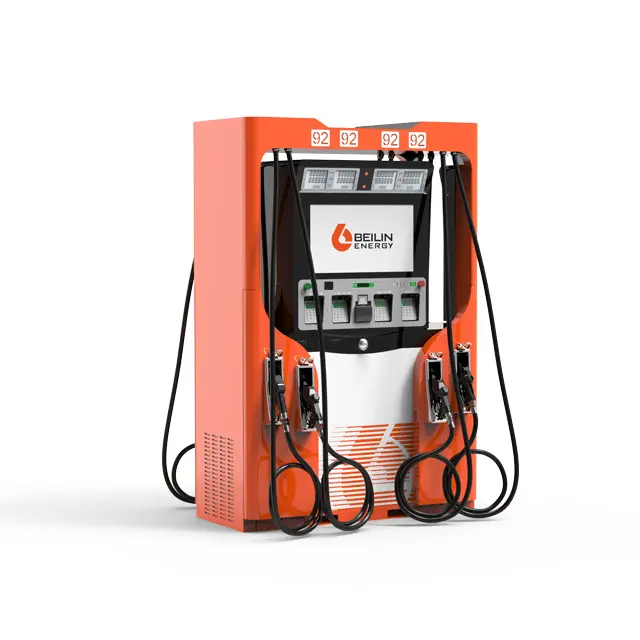
A fuel dispenser, by contrast, usually denotes the full terminal apparatus that receives fuel (often via a submersible or in-tank pump) and carries metering, control, valve, and delivery functions to the nozzle. The dispenser is the visible “customer touch” equipment.
Thus, the dispenser is the interface, whereas the “pump” may be internal (in-tank) or external (at the pump column). Many modern systems blur the boundary (i.e. the pumping element is integrated or submerged), but the conceptual difference remains in how fuel is delivered and where the pumping forces are located.
A major differentiator is where the pumping force is generated:
External suction pump (above-ground, “pump at the column”): The pump (motor + mechanical assembly) is co-located with the dispenser. The pump draws fuel upward through suction lines from the UST. This is typical in older, smaller setups.
In-tank/submersible pump (push system): The pump sits submerged in the underground storage tank. It pushes fuel upward to one or more dispensers, often through a shared manifold or distribution piping. The dispenser itself then only handles the metering, valve control, and nozzle delivery.
Because of this difference, the two systems differ in energy consumption, maximum lift, control architecture, and maintenance logistics.
Another important dimension is how many dispensers a single pumping system can support:
In a suction-pump setup, typically each dispenser (or each fuel grade line) has its own pump. The system is more decentralized.
In a modern dispenser architecture, a single in-tank pump or pump bank may serve multiple dispensers or multiple grades, feeding them through a distribution manifold. This centralization can reduce redundancy (fewer mechanical units), but introduces considerations of shared pressure, line balance, and redundancy planning.
From a station design perspective, the dispenser is part of the downstream architecture; the selection of pump style determines how dispensers are fed.
The physics of suction versus pressure pumping impose constraints:
Suction pumps are limited by the height (lift) they can reliably draw from, plus losses due to friction, vapor pressure, and cavitation. In long distances or deep tanks, suction pumps may struggle.
Submersible pumps push fuel upward, which is energetically favorable when lifting long vertical distances or feeding many dispensers. Push systems more easily overcome frictional losses in piping and can sustain greater flow hydraulic head.
Because of these dynamics, modern high-throughput stations tend toward dispenser systems with in-tank pumps to reduce energy losses and improve reliability.
Below is a side-by-side comparison summarizing functional, cost, and operational differences.
| Feature / Parameter | Suction-Pump (Pump-at-Column) System | Dispenser System (with In-Tank / Submersible Pump) |
|---|---|---|
| Pump location | At each dispenser (column) | Submerged in underground tank |
| Number of pump units | More units (one per dispenser or fuel grade) | Fewer, centralized pump(s) |
| Distribution complexity | Simpler piping per unit | Shared manifold and distribution system |
| Maximum lift and distance | Limited, sensitive to cavitation | Greater flexibility in vertical distance |
| Energy consumption | Higher per unit (less efficient) | More energy-efficient push delivery |
| Maintenance accessibility | Easier (above-ground access) | More costly (tank access required) |
| Redundancy and fault isolation | Independent units; failure of one affects one pump only | Shared pump failure may impact multiple dispensers |
| Scalability for high throughput | Less ideal at high volume | Better suited for high-volume operations |
| Use cases | Small stations, retrofit sites, low volume | Modern forecourts, multi-dispenser islands |
This table helps frame which architecture is more fitting depending on volume, station layout, and maintenance capabilities.
To make the distinction more concrete, let’s consider a modern product line: the YX Fuel dispenser. As a brand (or model) of dispenser typically offered by suppliers, YX Fuel dispensers assume a push-fed architecture, not a suction-pump system.
The YX unit is designed to interface with in-tank pump systems, meaning the dispenser itself does not contain the primary motor or suction pump.
It includes calibrated metering modules, flow control valves, circuit boards, human-machine interface (HMI), safety shut-off solenoids, vapor recovery interfaces, and nozzle controls.
It may support multiple grades through internal manifold switching, blending, or selector valves.
Because the YX Fuel dispenser does not house the main pump, it benefits from lower heat, simpler cooling, and modular serviceability of electronics and valves without disturbing pump mechanics.
When integrating a YX Fuel dispenser into a station:
Matching hydraulic head: The in-tank pump(s) must supply adequate pressure to overcome piping losses up to the YX dispenser nozzles, even under worst-case flows.
Redundancy: Decide if each fuel grade has its own pump or if a pump bank redundancy is required, since failure upstream could disable multiple YX dispensers.
Metering calibration: The YX dispenser’s meters and calibration must comply with regulatory standards (e.g. ±0.3 % or better).
Service strategy: Because the pumping hardware is remote, service plans must include access to tanks and isolation valves rather than focusing on the dispenser head itself.
Compatibility with vapor recovery and emissions controls: The YX Fuel dispenser must support vapor recovery and pressure equalization systems, often relying on upstream vapor pumps or recovery loops.
In summary, a YX Fuel dispenser is optimized for push-fed systems and abstracts away the pump mechanics from the visible fueling interface.
Knowing the distinctions, when might a station choose a “fuel pump” (suction-based) versus a dispenser architecture?
In a small station with only 1–2 fuel dispensers, short piping lengths, and modest throughput, a suction-pump system may be sufficient. Advantages:
Lower initial capital, because you avoid installing submersible pumps in tanks.
Easier servicing of mechanical units (above ground).
Minimal piping complexity and risk.
However, drawbacks include inefficiency and limited scalability. As volume grows or distance/piping complexity increases, suction systems may hit performance limits or reliability issues.
Modern stations with multiple islands, high throughput, extended piping runs, and stringent energy cost control will typically use dispenser systems (in-tank pumping + remote dispensers). Benefits:
One or few pump units supply multiple dispensers, reducing mechanical redundancy and cost per unit.
Better energy efficiency and lower maintenance per unit of fuel delivered.
More robust hydraulic performance over distance and vertical lift.
The trade-off is that maintenance is more complex (requires tank access) and pump failure risks can cascade to multiple dispensers.
In upgrading from old to new systems, station owners may replace old suction-pump columns with modular dispensers such as the YX Fuel dispenser, while converting piping and installing an in-tank pumping system. The transition must ensure pressure balance, proper control systems, and minimal facility downtime.
Distinguishing fuel pump vs dispenser is not just academic — it drives how stations are maintained, troubleshot, and serviced.
Suction-pump systems: Because pumps are located above ground, maintenance is relatively straightforward. A failing unit can often be swapped individually without affecting others.
Dispenser systems: The pump units are submerged; servicing them requires tank access, pulling pump modules, and possibly shutting down multiple dispensers. This increases downtime and coordination complexity.
Hence, a maintenance contract strategy must plan for scheduled downtime, redundancy, and isolatable sections.
In a suction-pump layout, a pump failure affects one nozzle/dispenser only. In contrast, in a push-fed dispenser system, a failure in the central pump can bring multiple dispensers offline simultaneously. Therefore, redundancy (e.g. dual pumps, backup pump banks) is more important in dispenser feeding systems.
Regardless of pump architecture, measurement accuracy is critical. Dispensers such as YX Fuel dispenser integrate precision meter modules that must be calibrated, regularly tested, and comply with weights-and-measures regulations. Miscalibration leads to revenue loss or regulatory violations.
Stations must implement a calibration schedule, temperature compensation (where applicable), and pulse verification. The location of pumping does not change the need for rigorous metrology.
Suction pumps above-ground are exposed to ambient elements, temperature swings, and mechanical stresses.
Submersible pumps are in a fuel environment, which is chemically stable, provides cooling, and reduces exposure to ambient wear. Thus, submersible pumps often enjoy longer lifespan in protected conditions.
Dispensers (e.g. YX Fuel dispenser) primarily host valves, electronics, hoses, and meters — components more accessible and less stressed mechanically.
Let’s walk through a hypothetical deployment of a YX Fuel dispenser architecture in a modern 4-island gas station to illustrate how the pump/dispenser distinction plays out.
Two underground storage tanks (Tank A for regular, Tank B for premium).
Each tank houses a submersible pump (Pump A and Pump B).
From each pump, manifold lines branch to the four islands.
At each island, dual-hose YX Fuel dispensers serve both regular and premium.
Control electronics at each YX unit manage flow selection, metering, solenoids, vapor recovery, and interface with point-of-sale systems.
The in-tank pumps maintain baseline pressure to all island branches.
Pressure sensors or regulators ensure uniform pressure across branches to avoid uneven flow or pressure drop.
The YX Fuel dispensers rely on upstream pressure — they do not need internal pumping motors — simplifying their design.
Each tank pump has a redundant secondary pump (Pump A2, Pump B2).
If Pump A fails, Pump A2 automatically takes over, maintaining supply to all dispensers of that grade.
Dispensers are isolated by automatic valves so that one island can be isolated for service without shutting down the other islands entirely.
If demand grows, additional YX dispensers can be added to islands without adding new pumps, provided pump capacity allows.
Routine meter calibration is done at dispenser heads (easy).
Pump servicing is scheduled during low-demand windows, and modular pump cartridges allow extraction with minimal ground disturbance.
By separating pump forces (in-tank) from dispensing heads (YX dispensers), the station achieves scalability, efficiency, and modular maintenance.
To decide which architecture (suction-pump or dispenser-fed) is optimal for your operation, consider the following factors:
Low-volume sites may not justify the upfront cost of in-tank pumps and manifold infrastructure — suction-based pumps might suffice.
High-throughput, multi-island stations almost always favor dispenser-fed architecture for efficiency and scalability.
If the distance between tanks and islands is short and vertical lift is low, suction pumping may still perform reliably.
But long runs, elevation changes, or complex layouts favor the push model of dispenser feeding.
If servicing simplicity and independent pump isolation is a priority (e.g. remote site with minimal staff), suction systems may be appealing.
If you can bear occasional pump access and plan redundancy, dispenser-fed systems offer lower total mechanical overhead.
Suction-pump systems have lower upfront CAPEX (no in-tank pump installation) but higher operating inefficiencies and more distributed maintenance.
Dispenser systems require higher initial investment (submersible pumps, manifold, valves) but lower per-liter running costs and simpler head-end maintenance.
If you plan to scale islands, fuel grades, or throughput, a dispenser-fed architecture (with YX Fuel dispensers or similar) allows growth without duplicating pump hardware at each island.
Using these criteria, you can model lifecycle cost, reliability, and flexibility to decide which architecture best fits your site.
In summary, the difference between a fuel pump and a fuel dispenser lies not merely in semantics, but in where the pumping action occurs and how fuel is delivered to the nozzle. A “fuel pump” in many contexts refers to a stand-alone, above-ground suction system, while a “fuel dispenser”—such as the YX Fuel dispenser—is a downstream interface that typically relies on an in-tank pumping system.
When designing or upgrading a fueling site, this distinction shapes your decisions on energy efficiency, maintenance strategy, redundancy, metering, and long-term scalability. Dispenser architectures dominate in modern, high-throughput forecourts, while pump-based systems still find application in smaller, simpler installations.
Choose an architecture that aligns with your volume profile, maintenance capacity, and growth ambitions. If you use YX Fuel dispenser technology, plan your pump and manifold system to deliver reliable pressure, redundancy, and calibration support to those dispensers.
Q1: Can a dispenser also contain the pump?
Yes — in some legacy or hybrid systems, a dispenser may include an internal pump (especially in small or standalone installations). But in modern forecourts, dispensers typically forego the pump; the pump is submerged in the tank or located remotely.
Q2: Does the term “fuel pump” include engine fuel pumps?
No — in this article, “fuel pump” refers to station/forecourt fuel delivery systems. Engine-mounted fuel pumps (inside vehicle systems) are a different domain entirely.
Q3: What happens if the pump (in-tank) fails in a dispenser-fed system?
It can disable multiple dispensers simultaneously. To mitigate this, many systems include redundancy (dual pumps, backup systems) or zone isolation valves so that one branch can still operate.
Q4: Are there performance or safety differences between pump and dispenser systems?
Yes — dispenser-fed systems with submersible pumps generally are more energy-efficient, have fewer cavitation issues, support better lift, and provide more stable flow. Safety systems (e.g. vapor recovery, emergency shutoff) still reside in the dispensers, not the pump, so dispensers must be compliant regardless of architecture.
Q5: How should I choose a YX Fuel dispenser when retrofitting an older station?
Ensure your current pumping architecture can supply sufficient pressure and flow to those dispensers. If not, plan to convert to in-tank pumps or add booster systems. Verify calibration compatibility, manifold design, and redundancy to protect dispenser uptime.


