

Views: 0 Author: Site Editor Publish Time: 2026-06-04 Origin: Site


Fleet managers, commercial real estate developers, and service station operators face immense operational pressure today. You must deploy reliable fast-charging infrastructure rapidly to meet surging electric vehicle adoption. The shift to electric mobility demands robust hardware to maintain operational continuity. However, selecting the right equipment often creates confusion, gridlock, and costly deployment delays.
This article evaluates power output ranges between 60kW and 400kW. We will identify when a unified charging solution makes the most architectural sense for your site. You will learn how to align hardware capabilities directly with site-specific grid constraints. We also explore how precise user dwell times dictate optimal power delivery. By understanding these technical dynamics, you can confidently navigate the complex transition from fossil fuels to electrified transport. You will build a future-proof facility designed for maximum vehicle throughput.
Output Matching: Selecting between 60kW and 400kW requires mapping precise user dwell times—from two-hour retail parking to 15-minute highway transit stops.
Architectural Efficiency: All-in-one units reduce installation complexity and footprint compared to distributed setups, though specialized scenarios may still require a discrete DC charging stack.
Infrastructure Transition: Upgrading from traditional liquid fuel models requires strategic spatial and electrical planning to maintain vehicle throughput and revenue parity.
Risk Mitigation: Transparent evaluation of grid capacity, local permitting, and hardware redundancy is critical to avoiding stranded assets and delayed ROI.
Deploying a commercial DC EV Charging Station begins with understanding user behavior. You cannot simply install the highest power unit and expect optimal results. Grid limitations and user dwell times must dictate your hardware selection. Overbuilding wastes capital, while underbuilding frustrates drivers.
Different commercial environments require specific power outputs. We categorize these into three distinct operational tiers. You must match the tier to your expected customer dwell time.
60kW - 120kW: This range works perfectly for commercial retail centers and destination parking. Drivers typically shop or dine for over 45 minutes. It also suits overnight fleet depots. Vehicles sit idle for hours, requiring steady rather than ultra-fast replenishment.
180kW - 240kW: Consider this the standard baseline for commercial transit hubs. High-turnover service stations benefit greatly here. Drivers expect to charge their vehicles in roughly 20 to 30 minutes before resuming their journey.
300kW - 400kW: Ultra-fast charging addresses heavy-duty commercial fleets. Highway corridor charging stops also demand this tier. Drivers require a 10-to-15-minute turnaround. Only specialized high-voltage vehicle architectures can accept this massive power flow.
Power Range | Ideal Commercial Site | Average Dwell Time | Primary User Profile |
|---|---|---|---|
60kW - 120kW | Supermarkets, Hotels, Workplaces | 45 - 120+ minutes | Shoppers, Employees, Overnight Fleets |
180kW - 240kW | Urban Gas Stations, Transit Hubs | 20 - 40 minutes | Delivery Vans, Rideshare Drivers |
300kW - 400kW | Interstate Corridors, Truck Stops | 10 - 20 minutes | Long-Haul Travelers, Heavy-Duty Trucks |
Modern dual-port systems utilize dynamic load balancing to maximize utility. Suppose you install a 120kW unit. When one vehicle plugs in, it receives the full 120kW. If a second vehicle arrives, the system intuitively splits the power. Each vehicle then receives 60kW simultaneously.
This software-driven feature drastically improves the perceived user experience. Drivers do not wait in queues. They plug in immediately. As soon as the first vehicle finishes and disconnects, the system instantly routes the full 120kW back to the remaining vehicle. You optimize grid draw while keeping multiple drivers satisfied.
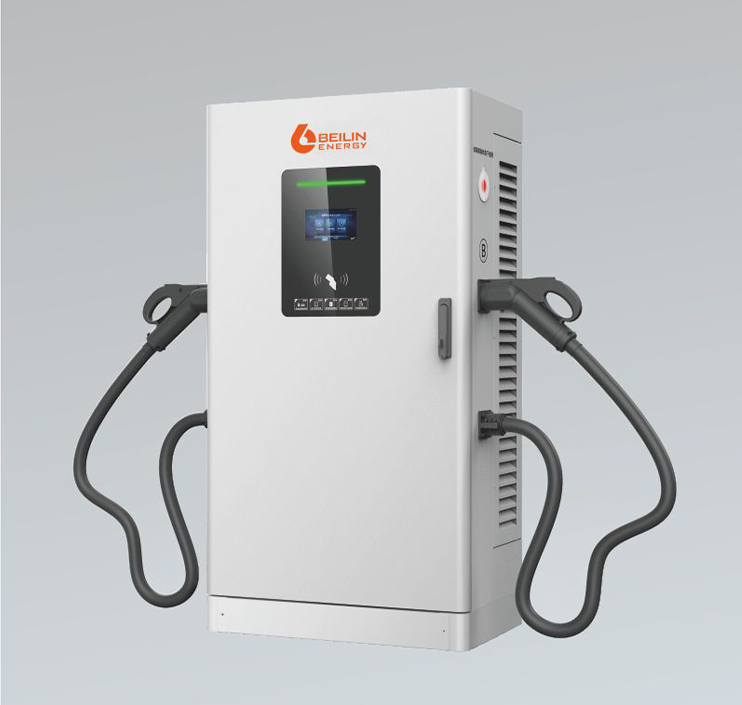
Site architecture plays a crucial role in your deployment success. You must choose between housing all components in one enclosure or separating them across your property.
Integrating power modules and dispensers into a single enclosure offers massive logistical benefits. You reduce the physical footprint required on your lot. Civil engineering costs drop significantly because you eliminate complex secondary trenching. Installers simply run utility power to a single concrete pad. Maintenance crews also favor this design. They access power modules, cooling systems, and screens from one centralized access door.
Some site constraints make all-in-one units impractical. In these edge cases, you must deploy a separated DC Charging Stack. The bulky power cabinet sits near the utility transformer. A sleek, slim dispenser stands in the actual parking bay.
Tight parking structures often require this separated layout to maintain vehicle turning radiuses. Flood zones present another common scenario. You can elevate the critical power stack safely away from water while placing the cheaper, user-facing dispenser at ground level.
Pushing 400kW generates extreme heat. You must manage this thermal load carefully. Manufacturers use either forced air or liquid cooling systems.
Forced air relies on massive industrial fans. These fans move ambient air across the internal power modules. They are reliable but produce significant noise. You must consider local noise ordinances if installing near residential zones. Liquid cooling pumps dielectric fluid through the charging cables. This keeps thick, heavy cords thin and manageable for users. However, liquid systems require routine pump inspections and fluid top-offs. You must balance ergonomic benefits against ongoing mechanical maintenance.
Chart: All-in-One vs. Distributed Architecture Comparison | ||
Feature | All-in-One Architecture | Distributed Architecture |
|---|---|---|
Installation Complexity | Low (Single trenching route) | High (Multiple trenches required) |
Footprint at Parking Space | Large (Houses power and dispensing) | Minimal (Dispenser only) |
Maintenance Access | Centralized | Fragmented |
Best Use Case | Open surface lots, retail centers | Parking garages, flood zones |
Transitioning from liquid fuels to electrified models requires strategic planning. Station operators cannot simply drop chargers where gas pumps used to sit. The physics of vehicle movement and driver behavior differ greatly.
Many legacy stations are ripping out older equipment. You might be planning to remove a KB Series Fuel Dispenser to make room for EV bays. This requires careful decommissioning of underground storage tanks. Perhaps your site currently utilizes a reliable XC Series Fuel Dispenser for diesel lanes. You must decide whether to augment these existing lanes or replace them entirely. Even a modern XF Series Fuel Dispenser takes up a specific spatial footprint that does not perfectly translate to EV charging requirements.
Traditional fueling islands rely on a pull-through traffic model. A car arrives, fuels for five minutes, and exits forward. EV charging bays typically require head-in or back-in parking. You must redraw your site plan to accommodate this changed traffic flow. Vehicles will remain parked for 20 to 40 minutes. If you simply replace gas pumps one-for-one with EV chargers, your overall daily vehicle throughput will drop. You must calculate the necessary number of charging bays to match your historical customer volume.
Longer dwell times offer a massive retail opportunity. You must position your chargers strategically. Place them along natural pedestrian pathways leading to your convenience store. While drivers wait for their batteries to replenish, they seek amenities. Clean restrooms, fresh food options, and comfortable seating areas drive high-margin in-store sales. Proper spatial integration protects your core revenue stream during the infrastructure transition.
Buying commercial hardware is a major capital event. You must look beyond slick marketing brochures and peak power claims. Rigorous vendor evaluation prevents you from acquiring stranded assets.
Avoid vendor lock-in at all costs. You must mandate strict software compliance from your manufacturers.
OCPP 1.6J or 2.0.1: Open Charge Point Protocol ensures your hardware can speak to any backend software network. If your software provider raises prices, you can migrate to a new platform without replacing the physical charger.
ISO 15118: This standard enables "Plug & Charge" functionality. Drivers simply plug in the cable, and the station automatically authenticates and bills the vehicle. It eliminates the need for credit card readers or smartphone apps, vastly improving the user experience.
Look past peak kW claims. Evaluate how the hardware handles internal failures. The best commercial chargers utilize modular power architecture. A 120kW unit might contain four independent 30kW power modules. If one module experiences a fault, the station does not go offline entirely. It simply degrades gracefully to 90kW. You keep collecting revenue while waiting for a technician. This modular redundancy is non-negotiable for commercial operators.
Hardware will inevitably experience issues. Your vendor's response time dictates your success. Demand robust Service Level Agreements. Scrutinize the warranty terms carefully. Ask vendors to guarantee specific uptime percentages, typically 97% or higher. Most importantly, verify their local parts availability. A great warranty means nothing if a replacement cooling fan takes three months to ship from overseas.
Many operators severely underestimate the friction involved in bringing a station online. Procurement is only the first step. You must navigate a complex web of local utilities and civil engineering constraints.
Utility timelines represent the biggest hidden risk in commercial deployment. You cannot assume your site has enough raw electricity. Operators must conduct comprehensive utility load studies before ever ordering hardware. Upgrading a local transformer often takes six to eighteen months. Utilities operate on their own schedules. If you buy hardware before verifying grid capacity, your expensive chargers will sit in a warehouse collecting dust.
Trenching through existing concrete destroys budgets rapidly. You must cut asphalt, lay conduit, pull thick copper wiring, and pour new concrete pads. Furthermore, commercial sites must comply strictly with ADA (Americans with Disabilities Act) regulations. You need specific spacing, ramp access, and screen heights for wheelchair users. Failing to account for these civil realities leads to failed inspections and costly rework.
Smart operators plan for the future while building for today. We highly recommend a phased rollout strategy.
Design for Peak Future Capacity: Size your utility transformer and underground conduit for 400kW ultra-fast charging right now.
Install Appropriate Current Hardware: Bolt down 60kW or 120kW units that match today's actual vehicle demand and lower your immediate capital exposure.
Scale Seamlessly: As EV battery technology improves and traffic increases, swap the hardware. Because the heavy underground electrical work is already finished, upgrading to 400kW becomes a fast, painless process.
Deploying a successful commercial fast-charging hub requires meticulous alignment of hardware, site realities, and user expectations. You must start by mapping exact user dwell times to determine whether a 60kW or 400kW output serves your customers best. Choose all-in-one architectures to minimize civil engineering complexity, unless specific site constraints demand a distributed setup. Most importantly, prioritize modular internal redundancy and open software protocols to protect your investment.
Your immediate next steps are clear. Initiate a comprehensive site utility audit immediately to uncover any hidden grid limitations. Then, develop a vendor shortlisting matrix based on long-term operational ROI rather than the cheapest upfront unit cost. By following this disciplined framework, you will build resilient infrastructure ready to capture the growing electrified market.
A: A standard commercial deployment ranges from 3 to 9 months. Hardware lead times take roughly 4 to 8 weeks. Local permitting and civil works add another 4 to 8 weeks. However, if your site requires utility-level transformer upgrades, the timeline can easily stretch beyond a year due to utility backlogs.
A: It depends on the internal modularity and external infrastructure. Some cabinets allow you to add extra power modules later if the chassis supports it. However, you cannot exceed the max capacity of your existing underground conduit and utility transformer without performing expensive new civil works.
A: EV chargers lack the mechanical pumps, hoses, and underground fuel filters of traditional dispensers. Instead, EV maintenance focuses heavily on thermal and electrical components. You must routinely clean air intake filters, inspect liquid cooling cables for leaks, and ensure software connections remain stable for payment processing.


